
Got $200 per Month? This ETF Could Turn It Into $455,865 With Minimal Effort on Your Part.
 2026-08-11 09:25
•James Brumley •The Motley Fool
•• ••
2026-08-11 09:25
•James Brumley •The Motley Fool
•• •• Axe Cap view
Why South Africans Should Think Twice Before Chasing US ETFs Blindly
Regular investing in S&P 500 ETFs is powerful, but South Africans might want to temper expectations considering the rand and local alternatives.
Putting aside $200 monthly into an S&P 500 ETF and watching it compound over 30 years is a compelling story often told in the US. For South Africans, it’s not quite that simple. Yes, funds like VOO or SPY offer solid exposure to America’s largest companies and have historically returned about 10% annually. But the rand’s gyrations against the dollar (USD/ZAR) can swing your local returns wildly. A strong rand could dampen gains, while a weaker rand boosts them. Still, relying solely on foreign assets ignores solid JSE options that can benefit from local growth and income streams, like the big banks (Standard Bank, FirstRand) or retailers (Shoprite, Woolworths) that tend to pay dividends. These companies offer some insulation from currency risk and can be easier to follow and trust if you’re new to investing. The risk in US ETFs is also rising with valuations overheated and potential US interest rate changes. If the rand unexpectedly strengthens or local economic data deteriorates, your assumed 10% return could fall short. this is just our opinion and not financial advice
For those starting with limited funds, mix a local heavy portfolio focusing on dividend-paying JSE stocks like Standard Bank and Shoprite with a measured exposure—no more than 20%—to US S&P 500 ETFs to hedge growth potential. Watch USD/ZAR closely to time further purchases.
- USD/ZAR
- Standard Bank
- VOO
- rand strengthening reduces USD ETF returns
- US market corrections hit S&P 500 ETFs
6/10
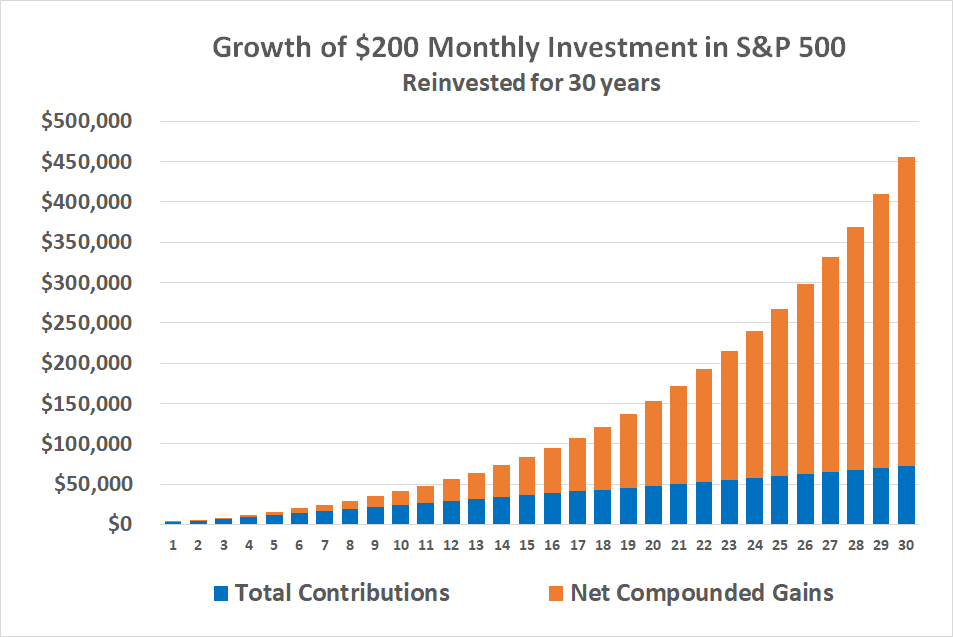
Investing just $200 monthly in S&P 500 ETFs could grow to approximately $455,865 over 30 years with an average 10% annual return. The article emphasizes the power of compound growth and automation, recommending index-tracking ETFs as the best option for most investors rather than actively managed funds that typically underperform the market.
Our take is based on reporting first published by The Motley Fool.
More stories like this
- Should You Own Walmart for Its Dividend King Status or Costco for Its Special Dividend? Here's the Answer.
- Amazon, Microsoft, and Alphabet: 2 Winners and 1 Loser in the Cloud Computing Arena
- Is Berkshire Hathaway Stock a Buy as Warren Buffett Successor Greg Abel Starts to Deploy the Company's Cash Hoard?