
Advanced Micro Devices vs. Sandisk: Comparing the Latest Quarterly Revenue Trends as AI Demand Spikes Sales
 2026-08-06 19:34
•Brendan Coffey •The Motley Fool
••••• •••
2026-08-06 19:34
•Brendan Coffey •The Motley Fool
••••• ••• Axe Cap view
AI Chip Race: AMD’s Steady Rise vs Sandisk’s Surge
AMD shows solid AI-driven growth while Sandisk’s flash memory boom delivers striking margin and revenue gains.
Artificial intelligence demand is reshaping the chip sector, and both AMD and Sandisk are riding this wave. AMD, with a well-established presence, posts steady revenue growth, hitting $11.5 billion last quarter. It’s shifting from a distant runner-up to a serious challenger in AI data centers. On the other hand, Sandisk’s flash memory business is exploding—from $1.9 billion to $9 billion in revenue—driven by hyperscalers needing premium storage. Its 77% net margin dwarfs AMD’s 14%, showing exceptional pricing power amid tight supply chains. For South African investors, this tech surge underscores why the rand’s USD/ZAR rate may stay volatile. Strong US tech earnings suggest risk-on mood, supporting the rand in risk phases but also exposing it when global tech cools. AMD’s sizable footprint and Sandisk’s explosive margins offer different investment profiles—balance is key. The view may be wrong if global AI investment hits a plateau or supply chain bottlenecks ease, reducing Sandisk’s pricing power. this is just our opinion and not financial advice
Hold AMD for steady AI-driven growth exposure, but trim into strength—valuations reflect this already. Watch Sandisk for a stronger growth play, but be wary of high margin sustainability. Monitor USD/ZAR for tech volatility spillover risks.
- AMD
- Sandisk
- USD/ZAR
- AI adoption slows globally, hitting chip demand
- Supply chain improvements reduce Sandisk’s price leverage
6/10
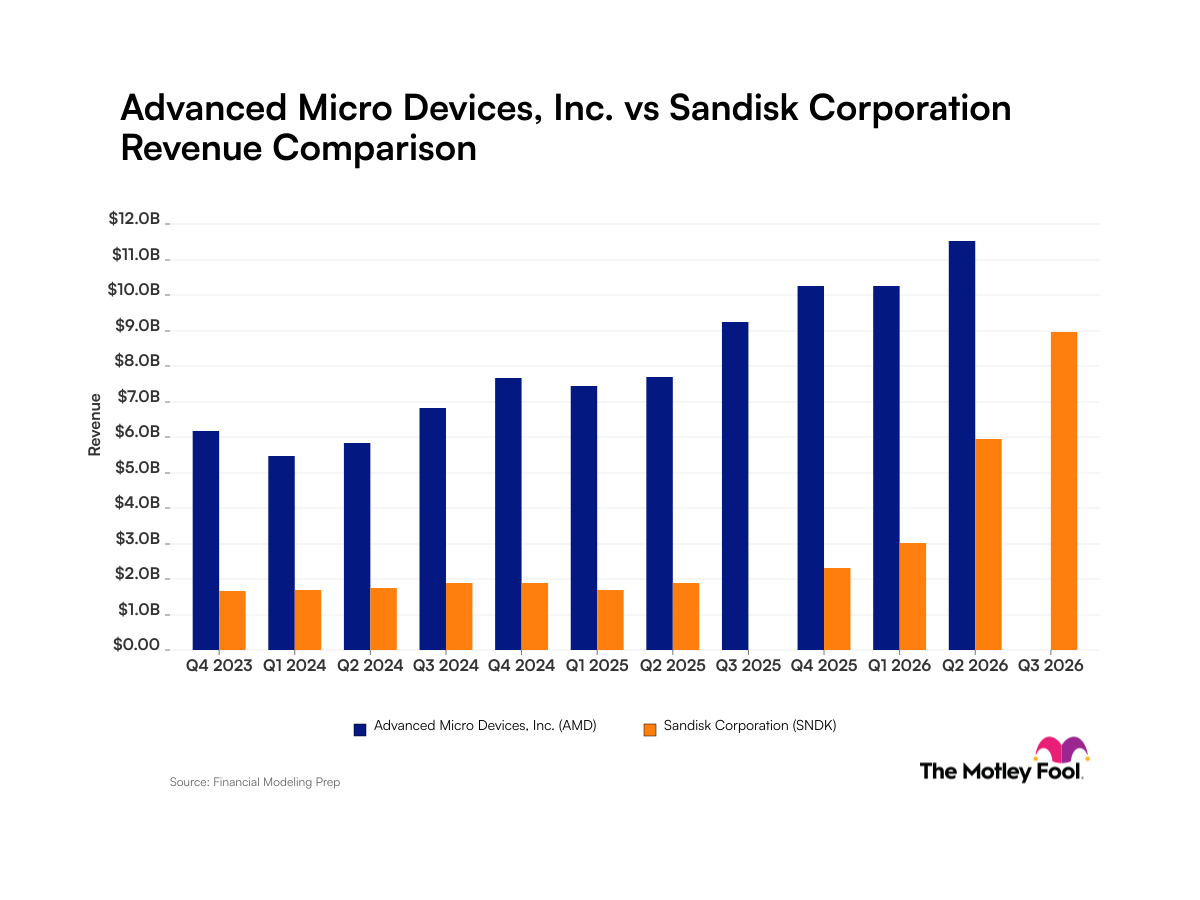
AMD and Sandisk are both benefiting from surging AI demand, but with different growth trajectories. AMD shows steady sequential revenue gains, reaching $11.5B in Q2 2026, while Sandisk displays explosive growth accelerating from $1.9B to $9.0B over the same period. Despite AMD's larger scale and stock gains, Sandisk's steeper revenue acceleration and higher net margins (77% vs 14%) explain its remarkable 2,900% share price outperformance.
Our take is based on reporting first published by The Motley Fool.